In becoming an economic geographer, a mum, and a middle-aged woman in an industrialized part of the world, and conducting research on mineral raw materials and technologies over the past decade or so, I have come to note the influence of Western philosophy and the many dualisms in language that structure life in this part of the world – man/woman, human/nature, production/reproduction. This creates tensions and shapes opposing sides: language as politics.
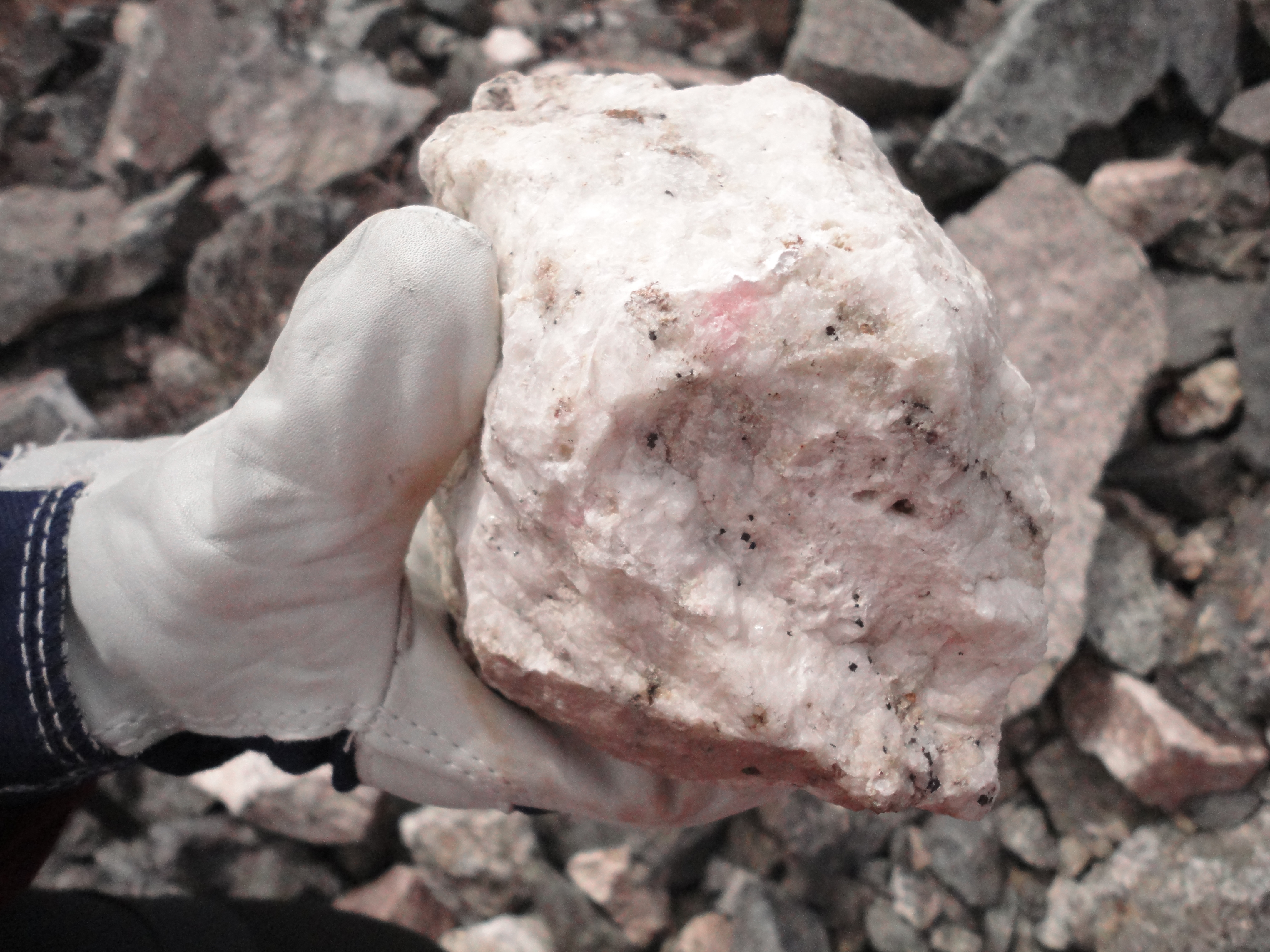
Why does this matter for what follows? The answer is rather simple: in constructing our worlds, awareness of the potency of language offers a gateway into learning and unlearning, acknowledging difference and appreciating the diversity difference enables towards co-existing ways of seeing and living in the world. Conversations may then be deciphered for the interests that shine through: Imagine taking off and putting on different pairs of glasses to look at the same subject, seeing the same thing, differently. I vividly remember how dear colleagues in geology and geochemistry presented a mineral sample, rather unimpressive in daylight, and exposed it to UV light in a darkened room – what did we see? A most beautiful reflection of colours was exposed. Reflections of a biophysical reality for the curious gaze of a human being. This is where this blog entry is situated: conversations on CRM illuminate practices and processes of transforming nature into resources.
Critical Raw Materials (CRM) do not exist, they are made. I will explain how and why. They are made in decision-making practices and processes. Critical raw materials are part of many conversations in the media and civil society, in government, in public organizations, in academia, in civil society organizations, in firms and industry associations. Many conversations on CRM reference them with regard to their use in technologies for energy, their role in the transformations of energy systems from fossil fuel energy carriers to renewable energies involving new (and old) infrastructures, and approaches to energy. These conversations on CRM also connect across various organizational forms and across multiple geographical scales – local, regional, national, supranational – with dynamics of competition and collaboration, and tensions and (dis)agreements around how to use land and (subterranean) mineral occurrences: conversations as expressions of thinking in economic terms.
Sorting conversations
How economic activities are understood, namely through which knowledge(s), by what theories and conceptual-analytical framework(s), informs whether many, some or only a few of these practices or processes are part of conversations. A conventional reading of ‘the economy’ will see conversations on CRM as forming part of processes of extraction, transformation or processing into components and products – the economy as the sphere of production. Reading CRM in more diverse ways implies moving beyond the sphere of production to the sphere of social reproduction, how material and social life is reproduced. Simply put, production of critical raw materials for whom and for what? Which and whose energy needs are met by the critical raw materials? How does this use of energy and of the necessary critical raw materials reflect on how human-nature relations are managed? This diverse reading of economies, reading for economic difference, acknowledges processes, and turns also to examining practices.
This turn to practices leads us to ask who is involved in the making of CRM. Experts have a role in this construction. Who are experts and how do they become experts? To be an expert suggests having expertise, special knowledge and experience in a particular field and topic. To categorize mineral raw materials into CRM necessitates a particular knowledge and skillset about elements and minerals, mineral occurrences, practices and processes connected to finding, evaluating and transforming mineral occurrences into resources and reserves. These are hints on who might hold this knowledge and expertise: physical scientists studying processes of the Earth, its formation from inner core to upper crust and to the atmosphere and space. Among these physical scientists may be physicists, chemists, and geologists. However, experts are also found beyond the physical sciences, in the social sciences and humanities, for example, studying how humans shape and understand the world. These may be anthropologists, sociologists, human and economic geographers. Experts are also found in civil society and nongovernmental organizations, in firms, in governments, in politics. And not least, Indigenous and local people affected by CRM extraction are key experts in understanding human-nature relations and consequences of extractive activities for this world.
Resource-making and the role of experts
Central to working out what experts do is understanding their role in shaping how society is ordered around resources. This is done in expert contributions to decision-making practices and processes, for example on the transformation of nature into resources. Experts convene in meetings for decision-making about (mineral) raw materials. They are asked to attribute values to raw materials based on two-dimensions – economic importance and supply risk. To be sure, the relation of these variables has also been made by other humans – what is of economic importance and what is a supply risk emerges from decision-making that ranks particular priorities of the sphere of production: production for economic growth. To return to the decision-making process: once raw materials are ‘qualified’ by experts in the sense that they are acknowledged, and allotted to these two parameters or variables, they are categorized as ‘Critical Raw Materials’. Thus, criticality, in the aforementioned sense, is constructed from the practices of experts who attribute worth to, and rank, particular attributes of raw materials according to defined variables and following a particular approach to structuring information.
Why is it important to understand critical raw materials as ‘constructed’? Expert knowledges in the physical or in the social sciences will carry different notions of worth, and experts will rank these notions of worth differently when ascribing them to the importance of mineral occurrences. If a balance in expert knowledges is not struck, decision-making will risk foregoing agreement from broader society. Recent evidence are protests such as in Serbia over whether or not to go ahead with lithium mining. Central here is how power operates in and through governance, in decision-making processes and practices. Here the role of political systems, of democracy, and the importance of institutions arises. Experts are able to offer a voice to various worlds of worth based on social contracts. This is important in the context of globally unevenly distributed mineral occurrences, and the work that CRM can do.
Critical raw materials at work
The critical in CRM legitimizes risk and offers an opportunity to operationalize it: the presence of CRM incentivizes state governments to draft CRM strategies, connecting with conversations over security of raw material supplies, such as in the Minerals Security Partnership. Strategic minerals connect industrial production interests with military and defence questions, facilitating prioritization of certain mining activities, for example the EU and Australia partnership on sustainable critical and strategic minerals.
The presence of CRM also enables reflection on the use of land, ‘on surface’ activities, relations with nature that offer livelihoods, and social and cultural practices connecting with social reproduction. Rights to and uses of land – through concessions or acknowledgement of particular practices by institutions – such as the UN, the UNDRIP, the UNESCO World Heritage site listing of the Sápmi, or the FAO Globally Important Agricultural Heritage Systems designation recognizing the Barroso region of Portugal – are important for the voices of smaller population groups that practice a variety of economic activities on land with mineral occurrences, and in democracies. This raises the question of making CRM for whom and for what: CRM serve social-environmental-political-economic interests in shaping political-economic activities of industrial production and social reproduction. Decisionmakers and experts working with CRM will benefit from knowing that CRM perform for, and are desired by, different interest groups.