5 FEBRUARY, 2025
By Adam Bobbette, University of Glasgow, School of Geographical & Earth Sciences, UK
We live in an age of political geology. From conflicts over critical minerals to wars for fossil fuels, geology is political. We need new ways of understanding how geology has shaped the modern world, and ourselves.
I became interested in political geology around 2016 when my colleague, Amy Donovan, asked if I would consider organising a workshop on the theme in the Department of Geography, University of Cambridge. I had been steeped in debates around the Anthropocene for several years. The Anthropocene is a scientific proposal, made by Paul Crutzen in a 2002 article in Nature called “Geology of Mankind,” to re-name our geological epoch after the massive impact that humans are having on the planet. According to Crutzen, humans are now a major environmental force, even transforming the earth’s systems. I was also inspired by Nigel Clark’s argument in Inhuman Nature: Social Life on a Dynamic Planet that social scientists and humanists have tended to leave difficult and profound questions about the materiality and history of earthly materials to natural scientists. I had also just finished spending a year on Mount Merapi, an active volcano in Indonesia, for my PhD fieldwork, which put me in direct contact with a highly dynamic geological force. I spent my fieldwork circulating between a scientific observatory at the base of the volcano and a village at the top to try to understand how different geological knowledge systems (so-called ‘modern science’ and ‘traditional knowledges’) related to each other. It became clear to me during my fieldwork that the science of geology, and the actual material stuff of geology, were profoundly, inseparably, political.
As I was working on my PhD, I became quite disillusioned with many discussions of the Anthropocene in the social sciences and humanities (see also the books The Anthrobscene by Jussi Parikka, 2014 & Anthropocene or Capitalocene? Nature, History, and the Crisis of Capitalism edited by Jason W. Moore, 2016). At the time, debates were raging about who was responsible for the Anthropocene, whether the term was appropriate, when it started, and what it means to live in this supposedly new era. What I found lacking was any real engagement with the science of geology. The Anthropocene, after all, was a concept developed in the earth and environmental sciences, and it was the first time in a very long time that concepts in the earth sciences had sparked such widespread debate in the social sciences and humanities, and far beyond. But most of the scholars that I was reading showed little interest in how it was that geological theories were created, or the broader social and political history of geology. Remember, I was asking these questions also in the context of my fieldwork on Mount Merapi, where geologists were often in highly complex, sometimes tense, sometimes respectful, relationships with people who practiced animistic-Islamic knowledges about earth processes.
It became increasingly clear to me as I worked on an edited collection with Donovan in 2018 with the title Political Geology: Active Stratigraphies and the Making of Life, that a great deal of reflection about the geological sciences, and their complicity in different forms of extractivism,was in order. This was because geology or earth science, as developed in Europe and North America, was implicated and used in some of the most egregious crimes of imperialism and colonialism. Geological prospecting and mapping transformed areas into resources to be extracted and led to the displacement of Indigenous peoples and the brutal disruption of their livelihoods. The scientific discipline of economic geology contributed expertise and technologies for extracting fossil fuels, the burning of which we now inherit as climate breakdown. The use of geological science to identify and then extract profitable minerals has contributed profoundly to the wealth inequalities that divide the Global North and South. These are only three of the ways that the geological sciences have contributed to shaping the geopolitics of the modern world.
Political geology, as I came to imagine it, would devote itself to documenting and making sense of these difficult histories.
But I also knew that the geological sciences weren’t only defined by colonialism and imperial expansion. Nor were the geological sciences only a European and North American tradition. We, in fact, live in a world full of geological knowledges and sciences. This is what my friends on Mount Merapi taught me: there are many ways to think about the history, structure, and evolution of the earth.
My friends on Merapi challenged me to think differently about geology when they explained to me that their ancestors inhabited the volcano. I was told that the spirits of ancient Islamic folk heroes lived near the crater and in the forests. Old Indonesian manuscripts described how spirits in the volcano were connected to a vast landscape that led all the way to the Indian Ocean and up into the heavens.
These accounts challenged the conventional distinction between nature and culture. The volcano was understood to be a living and vibrant being. According to those holding animist beliefs, geological material, therefore, also consisted of human histories.
What can the geological sciences learn from these ideas? Are there points of connection between the modern earth sciences and animistic conceptions of geological material? Are they as separate as we tend to assume? Is “modern science” really so different from folk belief and traditional knowledges? Some of the geologists that I met in the volcano observatory certainly held both visions together, because they worked as seismologists and gave offerings to deities in the volcano.
The western history of the geological sciences contains many alternative histories and routes not taken. I came to admire the work of Johannes Umbgrove, for example, a mostly forgotten Dutch geologist from the first half of the 20th century, who worked in the Netherlands East Indies (today’s Indonesia) and was inspired, in part, by the 19th century German Romantic vision of science. But Umbgrove was also influenced by Hinduism, Buddhism, vitalism, quantum mechanics, and more. He called for a “geopoetic” vision of how human life was connected to planetary and cosmic creativity. For Umbgrove, “geologising” was uncompromisingly aesthetic. It was meant to connect the “innermost depths of ourselves” to the cosmos. And he was disgusted by the exploitation of nature. Umbgrove was a crucial, and often forgotten, player in developing the theory of plate tectonics. We need more stories of inspiring characters like Umbgrove. But also, we need more stories about non-western geological scientists to disrupt the idea that geologists mainly came from Europe and North America.
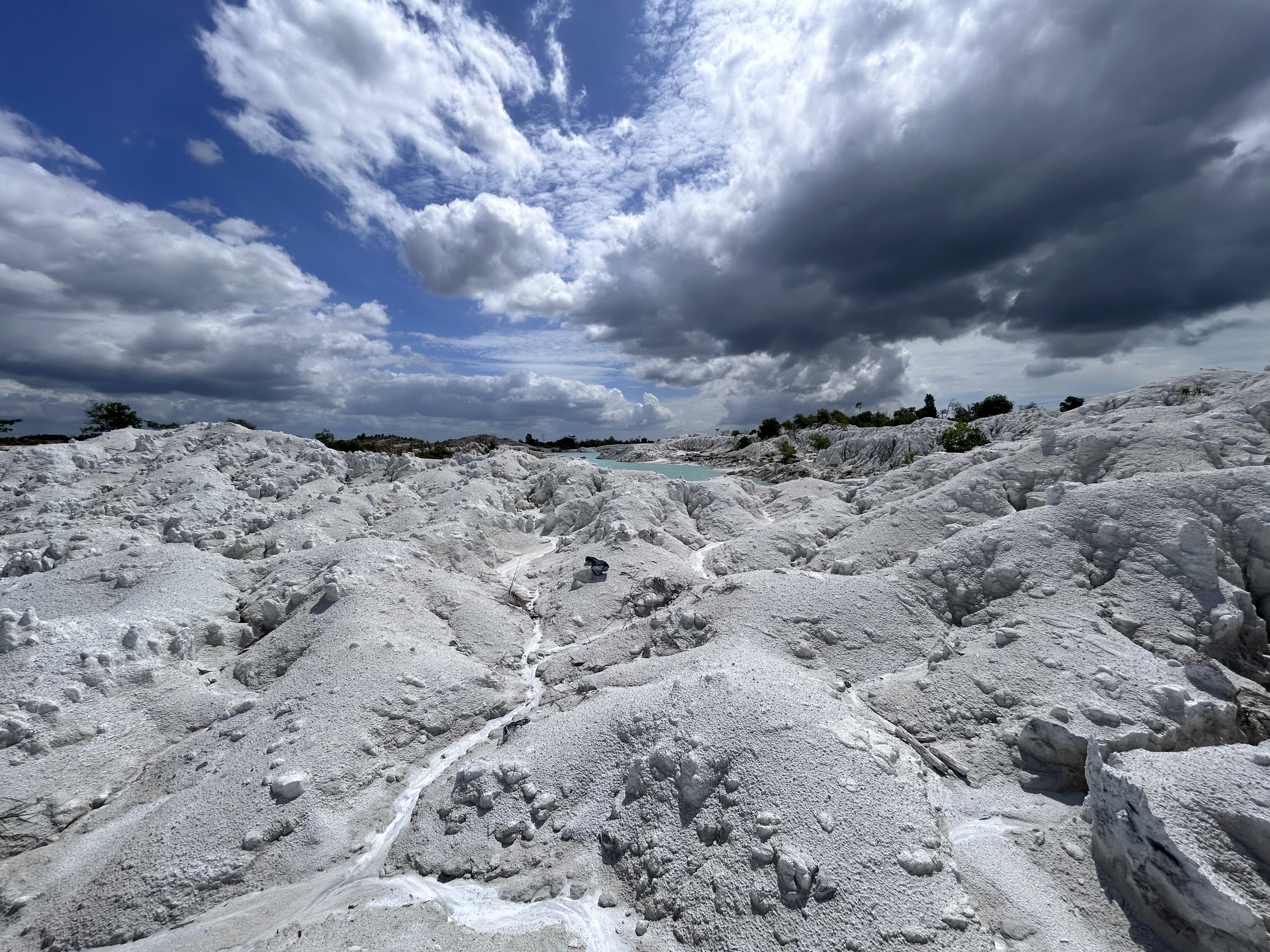
My current work has shifted away from volcanoes and towards critical minerals, partly because of the horrific damage that I have witnessed by critical mineral extraction on Indonesian landscapes. I’m also interested in imagining how the trade in critical minerals can be a vehicle for new, creative, and unexpected forms of global solidarity. But my intention is to carry forward the double-edged effort of political geology which I’ve been describing here: to face up to the difficult histories of dispossession and pollution resulting from mining , and to show that geology has many different practices and traditions. Stopping the brutality of critical mineral extraction, which does not happen without the input of geologists, requires that we critically reflect on how we typically define minerals as mere commodities to be extracted and sold (see also the book Geologic Life: Inhuman Intimacies and the Geophysics of Race by Kathryn Yusoff, 2024). Instead, we need to be creative and open minded, we need to experiment with new philosophies of the existence and the use of minerals: this is political geology.
To learn more about this topic you can watch a talk by Adam Bobbette titled On the Work of Political Geology in the Age of Critical Minerals at the Montanuniversität Leoben, AT.
Contact: Adam Bobbette – Adam.Bobbette@glasgow.ac.uk
Contribution: Ellen Marie Jensen (APRI), Gerti Saxinger (Uni Vienna & Austrian Polar Research Institute APRI)