FEBRUARY 19, 2026
By Simon Lobach, Fellow of the Swiss National Science Foundation, University of Vienna & Geneva Graduate Institute
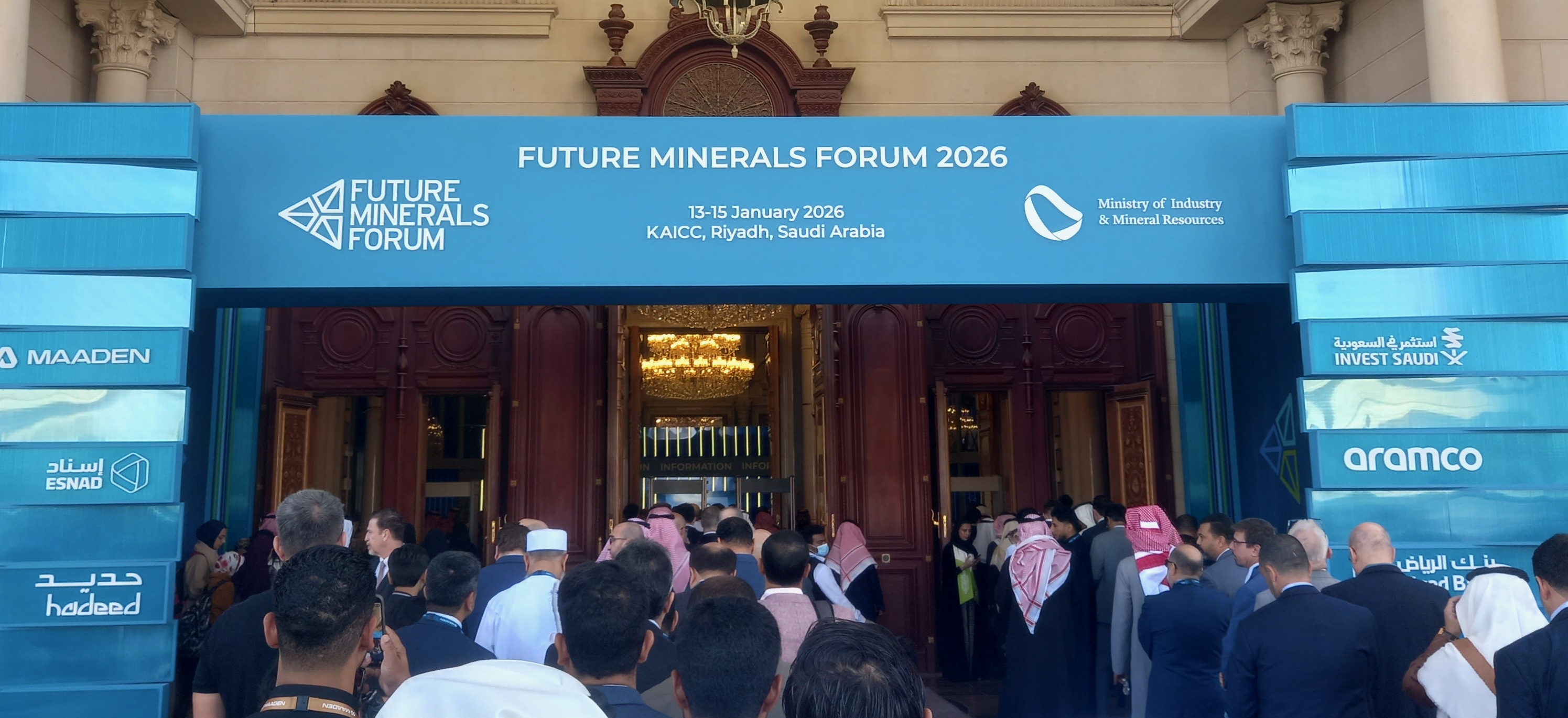
On a chilly yet faintly sunny morning in January 2026, I queue in front of the King Abdul Aziz International Conference Center – an enormous building showcasing a mixture of European belle époque architecture, Orientalist dreams, and something close to Disneyland – to pick up my entry badge for the Future Minerals Forum (FMF), held in Riyadh, the capital of Saudi Arabia. In the same queue stand white businessmen accompanied by junior assistants wearing their suits still slightly awkwardly; as well as foreign women wearing pantsuits; Saudi men in traditional white thawbs under red-and-white checked keffiyehs; and several young Saudi women, impeccably well-presented, their faces among the few visible features besides their black abayas. I am a guest of the government, as my visa states, as are all other foreign delegates attending. The entrance tickets are free of charge, though access is limited to professionals who successfully applied. My own application had been rejected two years earlier, before I had obtained my PhD. This time, I have more luck – or at least the right credentials.
Saudi Arabia has been organizing this conference on a yearly basis since the end of the global pandemic in 2021. This year, it received 20,000 participants, a record. The event has turned into “the Davos of mining”, said a foreign banker quoted in the international media. Once inside, I worm my way past the booths of companies selling items like centrifugal slurry pumps, transport solutions for tunnelling, and mining safety wear. As I reach the main conference room, I see the conference’s main slogan projected on many walls: “Dawn of a Global Cause”.
Indeed, Saudi Arabia presents itself as heading the global cause of facilitating the production of the metals needed for the energy transition. This may be surprising to some, as only a couple of months ago, during the Climate Conference in Belém (Brazil), Saudi Arabia made headlines by causing negotiations to last until dawn, after insisting the final document should make no reference to phasing out fossil fuels.
It’s quite understandable why the Kingdom is so deeply concerned by the idea that, at some point, the world will no longer be powered by the petroleum it pumps from its subsoil. Around 80% of Saudi Arabia’s exports consist of fossil fuels and products derived from them. The country’s population increased from 4 million in 1960, many of whom led a nomadic lifestyle based on camel herding, to around 30 million today. Yet it is very clear that this barren, arid country cannot possibly sustain the second-largest population in the Middle East. Saudi Arabia currently produces only 20% of the food it consumes, and even this is only achieved thanks to innovative farming practices and large-scale seawater desalination. The country thus exports oil and imports food, making it structurally vulnerable both to disruptions in local agricultural productivity and to shocks in the price or demand for petroleum products. The Saudi elites have even more to lose: their lavish lifestyles, built on oil revenues, as well as the power they wield over the country through the distribution of rents from oil exports. Power that depends on the continued political appeal of the country not levying a personal income tax.
To deal with the risk of losing the market for its oil, Saudi Arabia has attempted to diversify its economy. Its Vision 2030 document rests upon four pillars. The first is religious in character, but the three remaining ones determine the country’s economic direction. First, Saudi Arabia aims to become a global investment powerhouse; second, to become a strategic hub connecting Asia, Europe and Africa; and third, to develop its natural resources other than oil, so that “Our people will amaze the world again”. A few examples of how Vision 2030 is being implemented: the Kingdom has been purchasing agricultural land abroad in what has been described as a “land grabbing” strategy, particularly affecting African nations, particularly affecting African nations, as it wants to become a wheat trade hub for the wider region; it partners with technology firms to become a central pillar of Artificial Intelligence development, drawing on its cheap energy resources; and it prepares for hosting more major events to increase its influence (such as the 2028 WTO meeting) and improve its international image (like the Football World Cup 2034).
Then, there is the mining component. During the early decades of Saudi Arabia’s oil economy, the Kingdom had effectively priced itself out of the market as a location for mining. This only changed when political priorities shifted and the need to diversify became apparent. The state mining company Ma’aden (“Minerals”, in Arabic) was created in 1997, and partly privatized in 2008, with the state retaining a majority stake. Today, it is an influential player in copper, aluminium, gold, and phosphate markets.
To achieve this, the country took a series of measures, including “the reinforcement of the legal system”, alongside major investments in infrastructure and mineral exploration. Saudi Arabia’s mineralogical surveying budget increased eight times between 2022 and today, leading to the discovery of new “mining surprises” worth an estimated 2.4 trillion US dollars. What kind of minerals were found has not been revealed yet, but a representative of a US company involved in the surveying remarked on it during the Future Minerals Forum, saying that “Saudi Arabia has a very bright future”. Not that mining can start tomorrow, but almost. There is one task left, as a representative of a Saudi industrial agency remarked: “We need to free up the land to be ready for our investors”. Hence the “reinforcement of the legal system”, I suppose – because some of these lands, no matter how arid, may currently be in use for other purposes.
But not all mineral wealth can come from Saudi Arabia itself. As a Saudi minister observed: “ores are not always where you want them to be, they are where God put them”. As a result, he continued, they need to be brought to the hubs within Saudi Arabia where the “infrastructure and talent” are available to process them. This applies to minerals found in remote corners of the Kingdom, but also to minerals found abroad. The FMF was therefore not only attended by company representatives, but also by official delegations from a wide range of countries, many of which had sent their ministers of mining and natural resources. All were keen to obtain some of the investment funds that Saudi Arabia was making available for exploration and mining, mostly in Global South countries, for subsequent processing within the Kingdom, and for eventual export to the Global North: the “hub” function Saudi Arabia had outlined for itself in its Vision 2030 to provide the metals that the Global North apparently needs but is unable or unwilling to mine for itself. The projected lithium mine in Wolfsberg, Austria, is illustrative in this regard. Originally intended to supply lithium for processing in Saudi Arabia, the project has remained unrealized after ten years of planning and may never materialize. This underscores the pattern: as mining in the Global North is delayed or blocked, Saudi Arabia turns to the Global South for raw materials.
Saudi Arabia is in a hurry to secure these ores. One obstacle, however, is that many countries have regulations in place – sometimes at the demand of international investors or consumers – that prevent them from opening mines fast enough. To share experiences on how to deal with such challenges, the FMF contained a session titled “Rising mining nations: Success stories from the world’s most improved jurisdictions”. During a ministerial panel, the Moroccan minister brushed aside some of the Environmental, Social and Governance standards in place in the sector, remarking that “they have all been drafted in places like Geneva” and would therefore fail to take the actual development needs of African nations into account. The moderator, a renowned female CNN journalist, ended the session by asking each of the participating ministers how long it would take to obtain approval for a new mining project in their respective countries. The Canadian representative stammered something about efforts to bring the average down to two years. The Mauritanian minister could not answer the question, and instead mumbled in a mix of French and Arabic how pleased his country would be to receive Saudi investments. The debate was clearly won by the Saudi and Moroccan ministers, who proudly announced “between 30 and 90 days” and “30 days”, respectively. When a famous Oxford professor of economics later remarked on stage that in the UK, a mining project would need a hundred years to be approved, his comment was met with wholehearted laughter by the audience. The UK has adopted a different approach to securing critical minerals though: at the forum, ministers from Saudi Arabia and the UK signed an ambitious agreement to expand trade in copper, lithium, and nickel, sourced both from Saudi Arabia and from third countries.
If mining projects, in whatever jurisdiction, take a long time to be approved, this is usually for a reason. Before a green light can be given, social and environmental impacts must be assessed, and methods for mitigating these impacts developed; the limitations of the available tools notwithstanding. But this caution now seems to have turned into something to poke fun about: a symbol of an Old World stuck in its own regulatory frameworks. The message is clear: if we don’t want to lag behind China, we can no longer afford such navel-gazing, as “we need to be ready for our investors”. The USA, too, is on board. A special representative from the White House solemnly claimed that regulations have been changed and that environmental impact assessments can now be delivered within a month in the USA.
In the end, it’s all for the greater good: “the dawn of a global cause”. A Saudi minister argued that the very fact of the Kingdom hosting the FMF demonstrated how concerned Saudi Arabia was about climate change. The Kingdom’s investments in mineral surveying in all those countries – including many that are not exactly democracies – was not only “friendshoring”, but also “greenshoring”, as a senior Saudi representative put it. After all, does the world not need all those metals for the energy transition? So, if environmental regulations stand in the way, then they must be revised for the greater good of sustainability.
In another panel, the moderator asked the representative of a major US mining company what he meant when he used that word: “sustainability”. He clearly hadn’t expected that question. After stuttering briefly, he recovered, defining sustainability as “to do the right things, lower carbon emissions, and adhere to standards”. The problem, of course, is that those standards are simultaneously being loosened to enable delivery at the required speed.
After the last day at FMF, I take the Riyadh metro back to the hotel. Some carriages are designated as “family”. I find myself momentarily confused by the term, but then realize carriages are segregated by gender, with women not defined as such, but by what they are to men: family. Through the window I see a car driven by a woman wearing a niqab, and realize that she wouldn’t have been allowed to drive in this country before 2018. A uniformed member of the armed forces enters the metro, a young South Asian man immediately stands up to offer his seat. The soldier refuses, but the other keeps standing nonetheless, just in case. A few stops earlier, another South Asian man had already tried to offer his seat to me as well, even though I’m neither old nor disabled – I assume simply because I’m white.
During my layover at Sabiha Gökçe airport in Istanbul, I finally dare to look up some statistics that I didn’t know whether to consult while still in the Kingdom. Freedom House gives Saudi Arabia 1 point out of 40 for political rights, and 8 out of 60 for civil liberties, citing “pervasive surveillance, the criminalization of dissent”, extensive discrimination of women and religious minorities, as well as exploitation of the large expatriate labour force.
This is the country that will henceforward determine whether many of the minerals used in the energy transition are produced and processed according to social and environmental standards.
The dawn of a global cause.
Contact:
Simon Lobach – lobachs83@univie.ac.at
Contribution: Simon Batterbury (Uni Melbourne & Uni Lancaster), Alexa Burk (Geneva Graduate Institute), Gerti Saxinger (Uni Graz & Austrian Polar Research Institute APRI), Viviane Vaz (independent journalist, Brussels)
Funding: This trip to Saudi Arabia was part of my research project “Smelting Power: Histories and Futures of Mineral Processing Empires”, funded by the Swiss National Science Foundation (grant number 235290).