Listening, storytelling & learning
We want to engage in conversation with all relevant actors in the context of mining for CRM – with a focus on local and Indigenous communities – to collaboratively share and listen to voices, experiences, stories, and situated knowledge on mining from diverse perspectives. Such methods of ‘storytelling’ are used to highlight diversity of experiences and knowledge and build collaborative processes of listening and learning. We aim to use these insights to improve understanding of the landscape of mining for transition minerals and how to engage different local contexts and actors.
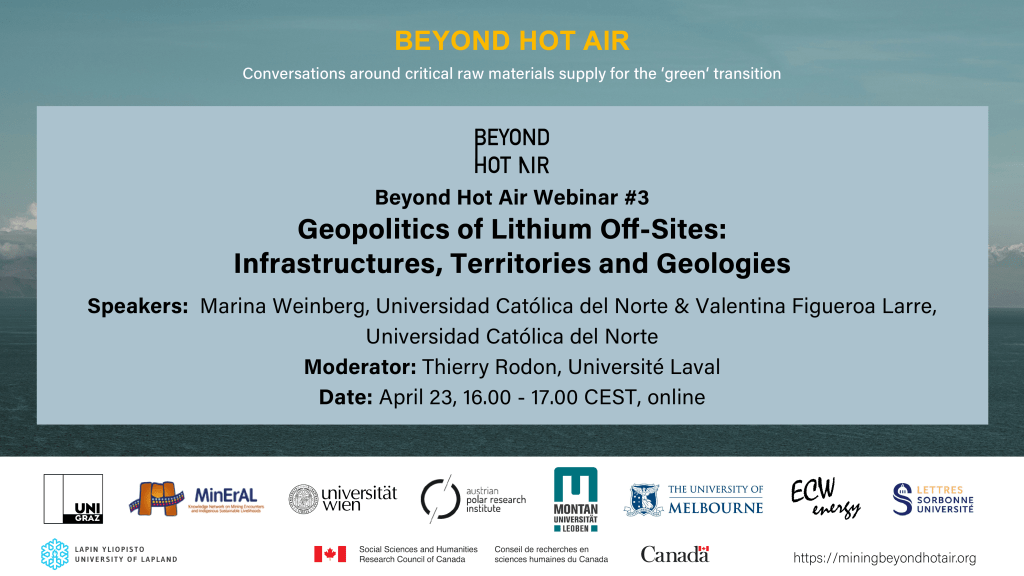
Beyond Hot Air Webinar #3
Geopolitics of Lithium Off-Sites: Infrastructures, Territories and Geologies
LiOness is an interdisciplinary research project based in northern Chile that examines the geopolitics of lithium through the concept of “off-sites.” In this webinar the speakers will discuss their approach to trace how lithium circulates across infrastructures, territories, and geoecologies, displacing materials, labor, and environmental impacts, rather than focusing solely on extraction sites. Combining social and natural sciences, the project studies how mining reshapes landscapes and everyday life in places such as the Atacama Desert and coastal zones. LiOness critically engages with energy transition debates, highlighting uneven effects, territorial conflicts, and situated forms of knowledge, while connecting local experiences with global processes of resource governance and extraction.
Speakers: Marina Weinberg, Universidad Católica del Norte & Valentina Figueroa Larre, Universidad Católica del Norte
Moderator: Thierry Rodon, Université Laval
Date: THU 23 April, 16:00-17:00 CEST
Zoom link: https://univienna.zoom.us/j/63528857188?pwd=L5PrB7ouKGlGi4LIMCaVJKR2CA4ntL.1
Note: The webinar will be recorded and will be made available to the public on YouTube and the BhA website. The Q&A part of the webinar will not be made public.
Beyond Hot Air Lecture #3 & IPW/CeSCoS Lecture
Can we reconcile Indigenous self-determination and extractive activities in Canada?
This presentation explores the reconciliation of Indigenous self-determination and extractive activities in Canada, focusing on the principle of Free, Prior and Informed Consent (FPIC). The United Nations Declaration on the Rights of Indigenous Peoples (UNDRIP), adopted in 2007, establishes FPIC as a key standard, requiring states to obtain the consent of Indigenous peoples before approving projects that affect their lands. However, FPIC remains controversial: while states see it as an obligation to consult, Indigenous peoples see it as a right of decision linked to self-determination.
The presentation analyses Indigenous appropriation of FPIC through legal challenges, negotiations and community-led impact assessments, such as the Squamish Nation’s process for an LNG terminal. Case studies, including uranium exploration in Quebec, demonstrate the growing role of Indigenous governance in resource development decisions. The conclusion argues that FPIC is a co-determination mechanism that requires meaningful engagement beyond consultation and industry agreements to reconcile Indigenous rights with state sovereignty.
Speaker: Prof. Thierry Rodon, Université Laval, Canada & IPW, Uni Vienna
Date: MON May 12 2025, 17.00 – 18.30 CEST
Beyond Hot Air Lecture #2 in cooperation with the Austrian–South Pacific Society (OSPG)
Compound Exposure in the Pacific:
Can we mine our way out of the climate crisis?
The prevailing solution to our planetary problem is a rapid transition to renewable energy-systems. Building these new energy-systems will require vast amounts of minerals and metals. This much is well known. Much less is known about the contradictions and risks that will accompany this particular solution to climate change. Many of the minerals and metals needed for renewables are located in places that are already acutely exposed to climate change, such as the Pacific. We expect that, in those places, extractive pressures and perils will converge with the impacts of climate change well before the transition to renewables kicks in and reduces climate threats. We call this contradictory process compound exposure. In this presentation we will discuss the features of compound exposure in the Pacific, hoping to open up a discussion on policy pathways to avoid its worst effects in the Pacific, and beyond.
This talk is based on the recent paper (2025) ‘Compound exposure: Climate change, vulnerability and the energy-extractives nexus in the Pacific’ co-authored by Nick Bainton (ANU), Emilka Skrzypek (St Andrews) and Éléonore Lèbre (UQ) and published open access in World Development.
Speaker: Dr. Emilka Skrzypek, Centre for Energy Ethics, University of St. Andrews/UK
Date: MON May 5 2025, 17.00 – 18.30 CEST
Beyond Hot Air Webinar #2
Strategic impact assessment in mining and what we can learn from the renewable energy sector
In this webinar, we bring together experts from the Austrian mining and renewable energy sectors to discuss the role of strategic impact assessment in decision-making around transition sectors. In particular we focus on decision-making. Transition policies often seek to speed up decision-making processes, thus undermining the ability of the public to have a meaningful role in decisions at an individual project level and lowering environmental standards. The webinar will discuss the possibilities for strategic impact assessment to enable meaningful engagement of civil society organisations and individuals at a more strategic level, before individual projects are approved. We focus on the experience of Austria, which has a well-developed renewable energy sector (mostly hydropower) and the emerging push towards more extraction of critical raw materials in the context of the EU Critical Raw Materials Act.
Speakers: Anna Leitner, GLOBAL 2000 and Viktoria Ritter, Ökobüro
Moderator: Emma Wilson, ECW Energy UK & BhA
Date: WED March 19 2025, 13.00 – 14.00 CET
BhA at Energy Café
Whose transition? Weighing up the costs and benefits of critical raw material extraction
Two members of the BhA team – Gerti Saxinger and Emma Wilson – held a talk on “Whose transition? Weighing up the costs and benefits of critical raw material extraction” at the Energy Café, hosted by the Centre for Energy Ethics at the University of St Andrews.
The term ‘Just Transition’ assumes that society is united around a global project to reduce carbon emissions. In practice, however, the notions of both ‘transition’ and ‘justice’ are highly contextual, and there is little agreement on the end-goal of a ‘just transition’ and the pathways to achieve it. Discourses around ‘green transitions’ are frequently criticised as being ‘hot air’, with unrealistic assumptions, empty promises, misinformation and greenwashing. In our talk we will highlight criticisms of ‘transition’ discourses raised by the Sámi Indigenous people of northern Europe. We will introduce two cases of planned mining in Norway and Swedish Sápmi that have been viewed as important for the green transition, but face substantial opposition from local Indigenous groups and environmental activists.
Click here to watch the recording of the talk on YouTube.
Click here to learn more about the Energy Café.
Speakers: Emma Wilson, ECW Energy Ltd (UK) and Austrian Polar Research Institute (APRI) & Gerti Saxinger, Uni Vienna (AT) and Austrian Polar Research Institute (APRI)
Date: February 25, 13.00 – 14.00 GMT
Conference
“Towards Fair Resource Policies for a Global Just Transition!”
In the context of the global energy transition, the demand for metallic raw materials is currently increasing around the world. Nevertheless, there is hardly any public debate on the questions of where and at whose expense these raw materials are extracted and processed. Thus, at this conference, we want to place fair raw materials policy and global just transition at the center of debates about socio-ecological transformations. The program can be found here.
The conference will open with a panel discussion on Wednesday evening January 29th, 18:00 titled “Greening the European Economy at the Expense of the Global South? Insights from Raw Material Exporting Countries”.
Venue: ÖFSE, Sensengasse 3, 1090 Vienna
Registration via e-mail: registration@oefse.at
The main conference will take place on Thursday, January 30th, 09:00 and Friday, January 31st, 09:00.
Venue: ÖGB Catamaran, Johann-Böhm-Platz 1, 1020 Vienna
Registration online here.
BhA supports this conference as a co-operation partner.
Beyond Hot Air Webinar #1
Critical Raw Materials Supply and Social License to Operate (SLO)
Beyond Hot Air Workshop
Conversations around critical raw materials supply for the ‘green’ transition
Public online sessions
Date: THU 16th of May, 11.30 – 13.00 CEST
Panel 1 – 11.30 – 12.15:
“The Critical Raw Materials Act (CRMA) and practical challenges”
Panel 2 – 12.15 – 13.00
“Geology – engineering – social sciences interaction & research’s societal impact”
Date: FRI 17th of May, 13.30 – 15.00 CEST
Panel 1 – 13.30 – 14.30
“Indigenous perspectives on broader political and local societal issues”
Panel 2 – 14.30 – 15.00
“Let’s keep on talking across stakeholders and society”
Please note: The sessions have been recorded and are available here.
The project Beyond Hot Air is a conversation. It is an international, transdisciplinary multi-stakeholder initiative that explores the complex landscape of critical raw materials (CRM) supply for the ‘green’ transition. The project is based at the University of Vienna, AT and associated to/funded by the Canadian research network MinErAL.
This workshop will bring together scholars from natural and social sciences, civil society actors, experts, Indigenous rights holders as well as political and corporate stakeholders to exchange knowledge and experiences of challenges and successful practices to enable more sustainable and socially accepted decision-making around mining for critical raw materials to advance the energy transition to be both ‘green’ and ‘just’.
We will focus on the complex relationship between mining and the energy transition. Combating climate change requires that all of us around the globe step out of our comfort zones – considering the full impact of mining for CRM on local communities and on the environment. We seek to dig deep to expose the dissonances, injustices and potential synergies in current debates, challenging the status quo.
Four sessions of the workshop are open to the public online and we look forward to your active participation in the conversation.
Beyond Hot Air Workshop Kick-off
Polar Talk #13 Green colonialism for the ‘green’ transition in the Arctic
Co-organized with the Austrian Polar Research Institute (APRI) and the Museum of Natural History Vienna (NHM)
Date: WED 15th of May 2024, 18.30 – 22.00 CEST
Venue: Museum of Natural History (NHM), Burgring 7, 1010 Vienna
Welcome: Kathrin Vohland, Director of the Museum of Natural History & Ulrich Brand, Head of the Department of Political Science, Uni Vienna
Speakers: Eva Fjellheim, Arctic University of Norway/Tromsø (UiT) & Institute for Human Sciences (IWM) in Vienna, AUT – Ellen Marie Jensen, Austrian Polar Research Institute – Thierry Rodon, Université Laval, CAN
Hosts: Simon Batterbury, University of Melbourne AUS & Lancaster University, UK – Gertrude Saxinger, Austrian Polar Research Institute APRI & University of Vienna
For further info see:
Polar Talk #13 at APRI (Co-organiser)
Polar Talk #13 at NHM (Co-organiser & location)
The implementation of the energy transition, the European Green Deal policy and the efforts of society in Europe to make the economy and people’s lifestyles ‘greener’ require renewable energies. For electric vehicles, wind turbines or digital devices etc., more and more critical raw materials such as lithium, cobalt, copper, rare earths etc. are needed. Many of these deposits and large-scale wind farms are located in the Arctic and sub-Arctic, which is also home to Indigenous Peoples.
The speakers are Indigenous and non-Indigenous researchers with deep knowledge of how Indigenous Peoples in Canada and Sápmi deal with corporate and political pressure and the legal conditions for industry and state intrusion into their lands. Polar Talk #13 will illustrate the power of Indigenous groups and their claims to self-determination, how some communities benefit from mining as well as the double standards of a society that wants to ‘go green’ at the expense of violating Indigenous rights and jeopardising peoples‘ cultural existence.